Sleeping Position | Choosing the Perfect Pillow
|
|
Tijd om te lezen 5 min
|
|
Tijd om te lezen 5 min
Choosing the right pillow isn’t about softness or brand — it’s about alignment.
Your sleeping position changes how your neck, shoulders, and spine are supported through the night. A pillow that works perfectly for one position can cause stiffness or strain in another — which is why so many people wake up with neck tension or shoulder discomfort even when their mattress feels “fine.”
In this guide, we’ll break down how side, back, and stomach sleeping each affect your alignment, how to spot whether your pillow is working against you, and how to choose support that holds up throughout the night.
If your main goal is better alignment and less tossing, start here: Side Sleeper Body Pillows & Hip Support Collection.
When you lie down, gravity shifts how your weight is distributed. On your back, weight spreads more evenly. On your side, one shoulder carries more of your upper body weight. On your stomach, your head is rotated to one side for hours.
Your pillow’s job is to keep your neck aligned with the rest of your spine. If your head tilts too far upward or downward, neck muscles stay subtly active through the night instead of fully relaxing — and that’s where morning stiffness often begins.
A pillow can feel “nice” at bedtime and still be the wrong height by 3am if it compresses or shifts.
Side sleeping is the most common position — and also the most sensitive to pillow height. When you lie on your side, your shoulder creates a gap between your head and the mattress. That gap needs to be filled, but not overfilled.
For people who wake up with neck or shoulder pain, side sleeping comfort usually depends on two things: correct pillow height and preventing hip rotation. If that’s your situation, these cluster guides go deeper:
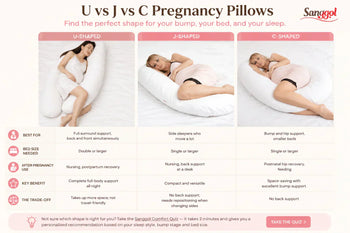
If you prefer targeted support (without a huge pillow taking over the bed), explore our J-Shaped Body Pillow. It’s designed to help stabilise the upper body and support the knees/hips to reduce twisting overnight.
Back sleeping can be a neutral position — but only if your pillow supports the natural curve of your neck. If the pillow is too flat, your head can tilt backward. If it’s too high, your chin is pushed toward your chest. Both can lead to morning stiffness.
Stomach sleeping is the most mechanically challenging position because your head must rotate to one side to breathe. The higher the pillow, the greater the rotation angle — which can increase neck strain over time.
Related guide: Is Stomach Sleeping Safe During Pregnancy?
Instead of guessing, look for patterns. Your pillow may be working against you if you notice:
These are “compensation” clues — your body is trying to create alignment manually.
Standard pillows mainly support the head. Body pillows support alignment. For side sleepers especially, supporting only the head often isn’t enough — because hip rotation can twist the spine and pull tension into the upper back and shoulder.
A well-designed body pillow can help:
Use this as a simple decision guide:
What pillow height is best for side sleepers?
High enough to keep your head level with your spine. Shoulder width and mattress firmness both change the ideal height.
Is a firmer pillow always better?
Not necessarily. Stability matters more than “firmness”. The key is consistent loft that doesn’t collapse overnight.
Why does only one shoulder hurt when I side sleep?
It’s often the side you sleep on most. Pressure concentration over several hours can lead to morning soreness.
Can the wrong pillow cause headaches?
It can contribute. Neck misalignment can create muscle tension that sometimes radiates upward.
Is my mattress the real problem?
Possibly — especially if it’s very firm or very soft. But pillow alignment is usually the easiest first adjustment to test.
Choosing the right pillow for your sleeping position isn’t about trends. It’s about alignment. When your neck is supported at the right height and your body stays stable overnight, sleep feels easier — and mornings feel better.
If you’d like to explore structured options designed to support side sleeping alignment and hip stability, browse our: Side Sleeper Body Pillows & Hip Support Collection.
Disclaimer: This article provides general sleep ergonomics information and is not medical advice. If symptoms persist, worsen, or include significant numbness, weakness, or severe pain, seek advice from a qualified healthcare professional.
2 minutes · Personalised
Not sure which pillow shape suits you?
Answer 5 quick questions about your sleep style, bump stage and bed size — we'll match you to the right pillow.
Take the Comfort QuizU · J · C Shaped
Find the pillow designed for your body
Three shapes, each built for a different sleep style and support need. Free UK delivery and 24-month guarantee included.
Shop Body PillowsFree downloads
Free guides, checklists and sleep plans
Download our free Mum-to-Be hospital bag checklist, birth partner guide and 7-Day Sleep Plan — no purchase needed.
Get the Free GuidesWant to keep reading?
Browse all articles by topic